Saturday, August 13, 2011

San Sebastian: Asador Etxebarri - Wood, Smoke and Ash

Etxebarri’s story has already been told and retold countless times. The restaurant is nestled in the rolling hills of the Axpe (with a population of 2 digits by my estimation) deep in Basque countryChef Victor Arguinzoniz practises unprecedented precision and finesse on the technique of grilling. His obsessions range from making his own charcoals in temperature–controlled ovens to manufacturing his specially-designed grills and grilling paraphernalia. For more on the restaurant and the man behind it, read this excellent article from Food and Wine.

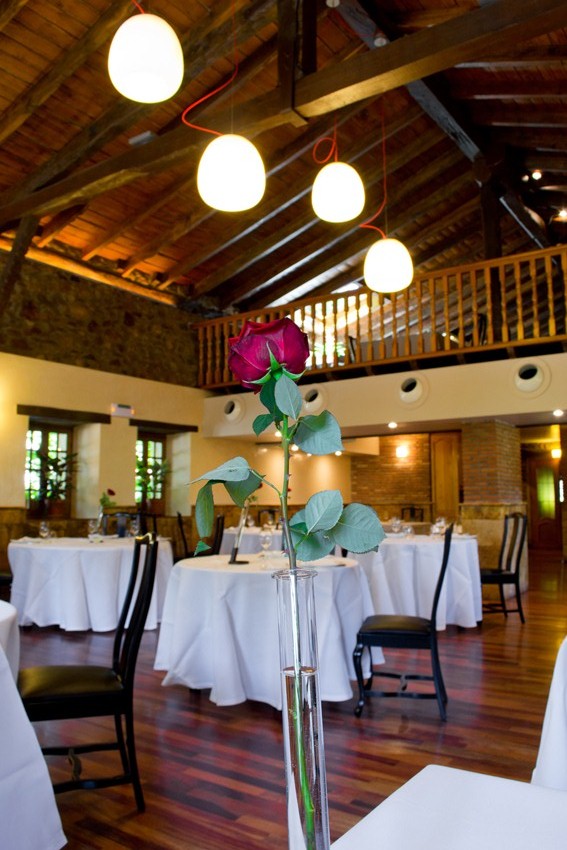
On the morning of the meal I met with Aleta, whom I met on the TripAdvisor board, who has kindly volunteered to drive us to Axpe and join me for lunch. It would have otherwise been a 2 hour trip each way by bus! Thank you Aleta! After a missed exit and a couple of false turns, we made it to Axpe. Etxebarri lies in its central plaza.


We settled down on a window side table looking out to countryside. The tasting menu looked terrific but I was also intrigued to try out their legendary house-made Chorizo. If both my wallet and my stomach were bottomless, I would have also gone for some clams, anchovies and a whole turbot. Alas, if only I had consecutive-day reservations!
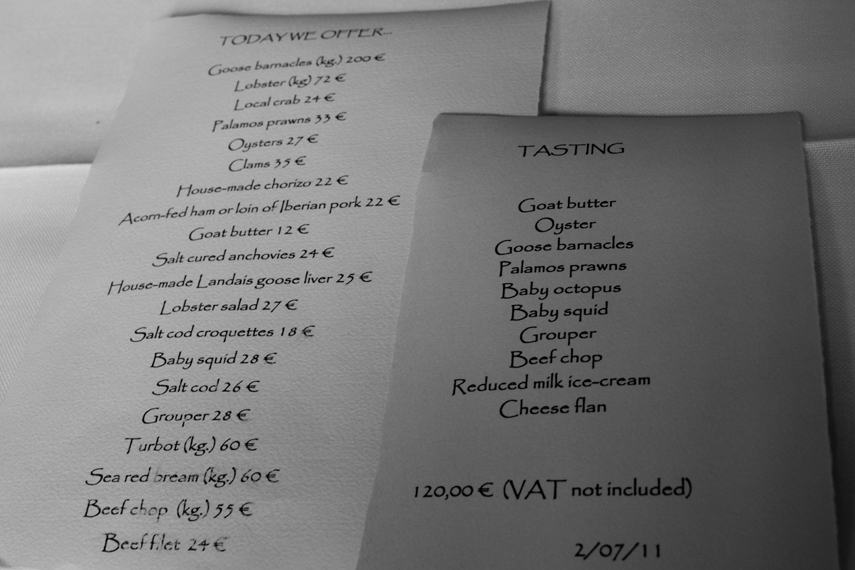

After an amuse of cubed beets, French beans and crisped bacon, we began our main meal with some fundamentals – bread and butter. An unabashedly-thick slab of hand-churned goat butter rest atop a hunk of grilled country bread. The butter was quite light and airy which magically dissolved in the mouth without leaving a trace of oiliness. Flecks of ashed salt imparted appropriate seasoning.


Next came an platter of Chorizo which we ordered a la carte. Perhaps dried charcuterie is just not my thing, but I found it rather unmemorable. Certainly, it was still much better than anything else I tried in Spain.


The tasting menu resumed with a massive oyster, shell intact. Underneath sits a plump oyster firmed gently on the hearth and branded with wisps of grill marks. It came with some smoked seaweed and its own juice. One typically characterizes oysters as salty, briny and soggy but Etxebarri’s interpretation, perhaps through a controlled dehydration on the grill, imbues a certain meatiness to the mollusk. Superb.


I was quite excited to try Percebes (Goose Barnacles) at Etxebarri for here, I will be definitely encountering the best examples of this mysterious delicacy. They are harvested from the ocean-pounded rocks of Galicia often at extreme risk to the Percebes divers. Consequently, even at the market, Percebes go for a mind-boggling 120 Euros/kilo. Resembling the toes of some prehistoric reptile, they look extremely out of place on the dining plate. The soft outer casing is peeled off to reveal the edible interior with the texture somewhere between a squid and a clam. The grill treatment adds a gentle smoky dimension to the sweetness and brininess.


Again and again, diners have declared Etxebarri’s prawns to one of the very best they ever had. These Gambas de Palamos, caught along the Costa Brava, are not exactly local produce but it is certainly a worthwhile trip northwards for these crustaceans to land in the hands of Chef Arguizoniz . When cooked, the hues of red and orange were so bright they threatened to bleed into the air. Interestingly, the aroma of wood fire on this dish is quite evident, even though the prawns themselves look very gently heated. Instead of sucking on the heads like savages, I split them open lengthwise to extract every drop of that elixir. The flavour is unfathomably rich with a sweetness that reveals itself only later. Heaven.


It is hard to follow up on the climax of the previous plate. Therefore, wisely so, the next dish of baby octopus and spinach played for me the part of a palate cleanser. The octopus is the most heavily charred and smoked item thus far (but still quite tender and mildly sweet) and when these characteristics are combined with the metallic spinach, it results in a refreshing bitterness.


The final dish before the mains was a quartet of baby squids on my caramelized onions. They were grilled with their skin still intact and then stuffed with their own tentacles. Blistered over intense heat, they rode an impossible balance between springy, tender and even crispy on the edges. I never knew that it was possible for squid to be so delicate and flavourful. They were undoubtedly of impeccable provenance. Yet another reference point dish.


A simple plate composed of a piece of grouper and summer vegetables, all grilled. The precision of the grilling was commendable – the tasty skin was quite crisp while the firm white flesh yielded to squeaky and juicy flakes. Visually, the coagulated proteins on the grouper made for a messy presentation but provided evidence of its freshness. The fish was minimally seasoned and allowed to speak for itself. The grilled vegetables were all nicely done but I felt that they were overcame by the heavy application of the lemon-butter sauce.


The final savoury course was another all-time favourite of Etxebarri. They use beef from retired Galician dairy cows at least 5 years old. Their age, combined with their grazing diet, results in a deep beefy flavour. Being a table of 3, we received a massive dry-aged beef chop grilled on the bone, sliced and perked with sea salt. Because of its relative leanness, the cooked surface of the beef is rather woody but the rare insides is pleasantly supple and tender if you manage to avoid the sinews. This made the chewing experience a little tedious. The fat, tasting richly of butter and hazelnuts, was unfortunately trimmed off most parts of the steak. I also wish that they left the cap on, for that is my favourite cut of beef!


Next, a perfect quenelle of reduced milk ice cream in a pool of wild berry sauce. Some report that the milk has been smoked but I could not detect any hint of it. However, the ice cream is still quite unmatched in smoothness though I would have liked it better if served more chilled and firmed.


The second desser was a wobbly cheese flan so delicate that its metal mould was only removed upon service. Even though ordinary in appearance, its depth of flavour blew the socks off the previous dessert. Creamy, cheesy and eggy, it was an ultimate comfort dessert.


I will be back for more.


Tuesday, June 7, 2011

Paris: Chez l'Ami Jean

Here's some pictures from Chez l'Ami Jean. It was an overall excellent experience with both the food and service. I am not going to write about it now as I am hoping for a second meal in July to make a better assessment.


Saturday, March 26, 2011

A Teaser

Just to torture some of my readers (you know who you are!). Here's a teaser of what to look out for in about 2.5 months during my trip:

Asador Etxebarri - Mecca of grilling perfection. My entire schedule was planned around this lunch. Read more at Yaokui.

Chez l'Ami Jean
- Recommended by Gastroville as well. How can I go wrong? Read more at Hungry in Bangkok.

Pizzeria Sorbillo - We only have time for one (or two if we rush) pizza in Naples. I hope this is a right choice. Read more at Scattidigusto. Use Google Translate!

La Cuchera de San Telmo - Best Pintxos on Earth? Read more at Dudes on Food.

and many many more!

Friday, March 25, 2011

Dusting Away the Cobwebs

Ah I’ve been too busy to work on this blog on mine. Taking 3 Physics and 1 French module was a bad idea. Especially the French! Still, it’s not completely due to tedious academic work that I’ve been neglecting my virtual presence – I’m also hammering out my vacation details this summer. Yes, I am Europe bound!

Anyway, it doesn’t mean that when my blogging stop, my cooking halts too. I always say I am a foodie first, then trailing far behind, a photographer and then a blogger. Here’s a duo of my effort in the past months. In case you are wondering why deep-fried themes seem to cluster together, it’s called oil recycling.

I made a second attempt at fish and chips with some appreciable improvements. Instead of depending on an oil thermometer, I winged the oil temperature and did not too badly. I got the blanching of the fries spot on but I think my deep frying temperature was a tad too high. Still, I suspect that it’s not completely because of the temperature that my fries turned out more brunette than blond. I think that the residual sugar in the potato is browning prematurely. Perhaps they needed a more thorough rinsing. For the fish, I used the same batter but this time I employed the Japanese tempura trick of sprinkling more batter on the fish after dropping it in the oil.


The next preparation is unabashedly lifted from the menu of the Parisian 3-star restaurant Ledoyen. I read about it on Gastroville and Food Snob and even though it’s simple prawn ball, I am strangely attracted to it. And boy, when I tried to replicate it, I found that there’s nothing simple about it at all. First, I tried substituting the pastry with shredded wanton skins. Fail. Next, I used spring roll sheets. It was passable, but only just. I finally gave in and used phyllo pastry and shredded it filament thin. Success! The filling was a whole tiger prawn as well as some minced prawns to give it shape.


Though impressive looking, I found these prawns inferior in taste and texture to smaller deep sea prawns. It is ‘garnished’ with a grilled half of another prawn. The saucing component was what perplexed me. I thought it was some sort of foam that’s not accessible to a home kitchen until I chanced across La Recette du Jour with its recipe for a Lemon and Olive Oil Mousse dessert. Obviously I couldn’t replicate exactly the recipe but only draw inspiration to come up with a savoury version of it. With all 3 elements in hand, the constellations aligned and there you have it, a 3-star dish.

Tuesday, January 18, 2011

A Birthday Gift to Myself

After a year and a half of resistance, I finally broke down and bought from Korin.com the Suisin Hayate Yanagi-ba on the final days of the Winter Sale. This knife was forged by Master Smith Keijiro Doi “under the lowest possible temperature so that there is minimal carbon migration from the hagane (cutting edge) to the jigane (cladding)”. It is said that the success rate of this type of forging is southwards of 20%. Such is the quality of his work that even partially successful blades, sold under the stamp of “Hayate Light”, still command over US$400. Doi-san has been forging knives since 1946. Here’s a mesmerizing video of his manufacturing process from Chef's Armoury:


I was, in fact, yearning not only for the Hayate but the Shiro-Hayate. The difference being that the Hayate uses Hitachi Blue #2 steel – a tougher alloyed steel while the Shiro-Hayate employs the White #1 – a pure carbon steel that attains unparalleled sharpness. Sadly, Doi-san has stopped working with White #1 a few years back due to his declining eyesight.


I had bought the knife without any intention of using it – at least until I have the skills to justify it. Right now, it will remain as a drawer queen. Here’s it with my other drawer queen, also from Suisin, a Gin #3 (stain-resistant) Damascus Funayuki.